
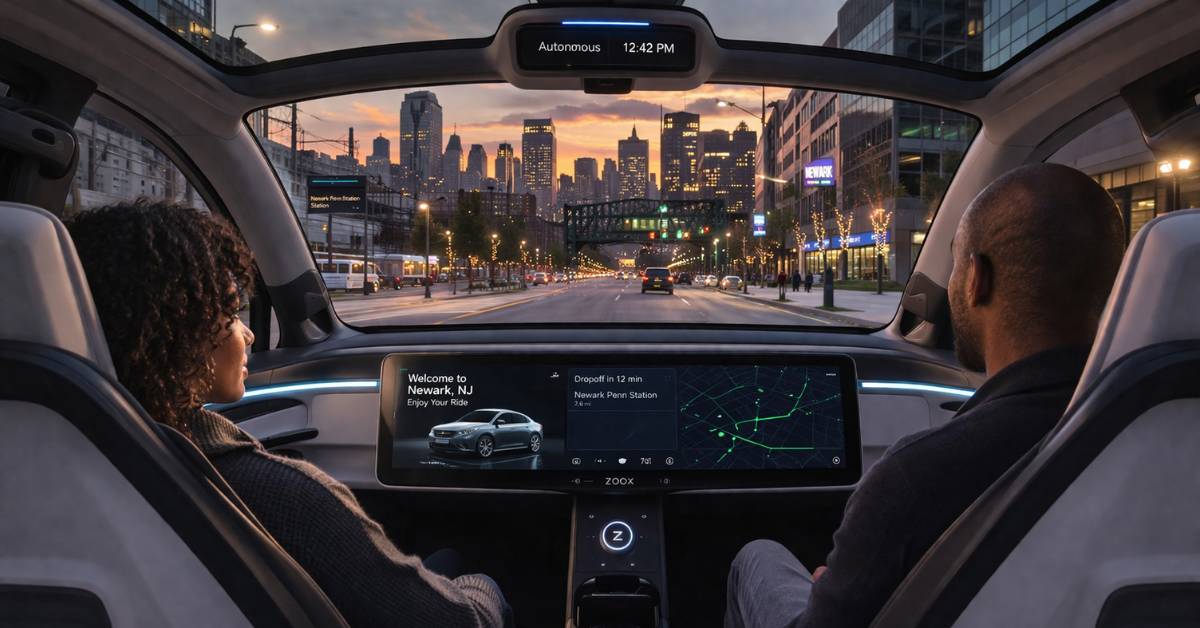
Let me paint you a picture: you just landed at Newark Liberty after a brutal six-hour flight. You’re tired, your bag is heavy, and the ride-share surge pricing is, as always, insulting. Now imagine instead that a sleek, driverless car rolls up to the terminal, your name is on the screen, you hop in, and it takes you straight home without a word of small talk. No aggressive merge on the Turnpike, no argument about the route, no tip calculation at the end.
That’s the promise of self-driving taxis. And whether people realize it or not, New Jersey is already stepping into that future.
But before we jump to conclusions and declare “robot taxis are here,” let’s slow down and look at what’s actually happening, especially from the perspective of everyday commuters and airport travelers.
The Current Reality: It’s Already Happening (Just Not Everywhere)
Self-driving technology isn’t a concept anymore. It’s being tested in real environments, including New Jersey.
One of the biggest developments is happening at Newark Liberty International Airport, where the Port Authority has begun testing autonomous shuttle systems. These are electric, self-driving vehicles designed to move passengers between terminals, parking areas, and transit hubs.
Now, before expectations get out of control, these are not public taxis yet. These trials are happening in controlled environments. That means predictable routes, limited variables, and fewer surprises.
Why start here? Because airports are among the easiest places to test automation. The roads are structured. Traffic patterns are more controlled. And the routes are repetitive.
In simple terms, it’s the safest place to let robots learn before letting them loose on regular roads.
Why Airports Are the First Battleground?
If you’ve ever traveled through Newark, you already understand why airports are the starting point.
Airport transportation is chaotic, with:
- Flights operating at odd hours
- Demand spikes unpredictably
- Ride availability is constantly fluctuating
- Pricing can swing wildly
This creates the perfect use case for automation.
Self-driving taxis and shuttles can operate continuously without worrying about driver shifts, fatigue, or availability. They don’t cancel rides or take breaks. They don’t reject trips because it’s “too early” or “too short.”
For airport authorities, this also means lower operational costs over time. Traditional shuttle systems require staffing, maintenance coordination, and scheduling. Autonomous fleets simplify a lot of that.
There’s also a long-term plan to integrate these systems into larger infrastructure projects, such as the upcoming AirTrain Newark upgrade, expected around 2030.
So the vision is bigger than just replacing a taxi. It’s about creating a seamless journey with no friction, waiting, or guesswork.
What About Uber and Local Taxis?
The ride-hailing shift is the obvious question we will face if self-driving taxis arrive. The question is what happens to traditional taxi ride services?
Companies like Waymo have already begun mapping parts of New Jersey, including Jersey City, Newark, and Hoboken. There have also been early-stage tests near Newark Airport.
So yes, the shift is happening, but it’s not happening overnight.
New Jersey is taking a cautious approach. Proposed regulations could require autonomous vehicles to have a human operator present for the first few years. If that goes through, full driverless taxi services could be delayed until around 2027 or 2028.
That might sound slow, but it’s intentional. Transportation isn’t like launching a new app. One mistake can have serious consequences. Regulators are trying to balance innovation with safety, which naturally slows things down. So for now, Uber drivers and local taxi services are still very much part of the system.
What Commuters Actually Care About?
We have to answer this question honestly. We all know most commuters don’t care about AI, automation, or futuristic technology. All they care about are three things:
-
Reliability
Will the ride show up on time? This is where self-driving taxis have a real advantage. Since there’s no dependency on driver availability, the system becomes more predictable. The commuter doesn’t have to face last-minute cancellations or wait for a driver to accept their ride. For airport travelers, this alone is a huge upgrade.
-
Cost
Will self-driving taxis be cheaper? In theory, yes, because removing the driver reduces labor costs, which should lower fares over time. But in the early stages, don’t expect dramatic savings.
The technology itself is expensive. Development, maintenance, and infrastructure costs are high. Initial pricing may be premium.
Think of it like early ride-sharing apps. They started cheap, then normalized pricing over time. Autonomous taxis might follow a different path, starting out expensive and gradually becoming affordable.
-
Safety and Trust
Can people trust a car without a driver? This is the biggest hurdle.
Companies like Waymo have reported significantly lower crash rates compared to human drivers. But statistics don’t always convince people. Perception matters just as much as reality.
One high-profile accident can create hesitation, even if the overall system is safer. So adoption will depend heavily on public trust, not just technology performance.
From Taxis to Transportation Ecosystems is a Bigger Shift
Self-driving taxis aren’t just about replacing drivers. They’re part of a much larger shift in how transportation works. Globally, cities are moving toward something called Mobility-as-a-Service (MaaS). This means integrating different modes of transport into one seamless system.
Instead of thinking in terms of “I need a taxi,” the system becomes:
- Book your journey end-to-end
- Combine trains, shuttles, and cars
- Optimize routes automatically
In this system, autonomous vehicles play a key role, especially for first-mile and last-mile connectivity.
In New Jersey, this could look like:
- Taking a train to Newark
- Using an autonomous shuttle to reach your terminal
- Eventually, booking a self-driving taxi for local travel
It’s less about individual rides and more about connected journeys.
Challenges That Could Slow Everything Down
As promising as this sounds, there are real challenges.
Regulation
New Jersey is not rushing into full autonomy. Safety rules, liability concerns, and infrastructure readiness all play a role in delaying rollout.
Infrastructure
Self-driving systems require more than just cars. They need:
- Smart roads
- Reliable mapping systems
- Communication networks
And without these, scaling becomes difficult.
Public Perception
People are skeptical of change, especially when it involves safety. Even if autonomous vehicles are statistically safer, emotional trust takes time to build.
A Realistic Timeline
Let’s remove the hype and look at what’s actually likely.
| Year | What Will Happen? |
| 2026-2027 |
|
| 2028-2029 |
|
| 2030 and beyond |
|
According to this timeline, you won’t be using a fully autonomous taxi everywhere next year. But it doesn’t mean you have to wait for decades to use them.
What Does this Mean for Airport Travelers in New Jersey?
For people traveling to and from Newark, the impact will be felt first and fastest.
They can expect:
- More reliable early morning and late-night rides
- Reduced dependency on driver availability
- Gradual integration with airport transport systems
The biggest shift won’t be flashy but subtle. They will have fewer missed rides, less uncertainty, and more consistency. And honestly, if you ask any traveler what they want, they’ll answer all three of these factors.
Read more: Car Service Monroe NJ: A Smarter And Less Stressful Way to Get Around
Parting Note
Is This Really the Future? Self-driving taxis are not a distant concept. They’re already being tested, refined, and slowly introduced into real environments.
But they’re not replacing everything overnight. In New Jersey, the transition is practical, not dramatic. It starts with airports. It expands into dense urban areas. And only then does it become part of everyday commuting.
For now, human drivers still dominate the roads. But the next time you book a ride to Newark, there’s a good chance that in a few years, the person behind the wheel won’t be a person at all.
And if it gets you to the airport on time, without cancellations or surge-pricing stress, most people won’t care who or what is driving.